


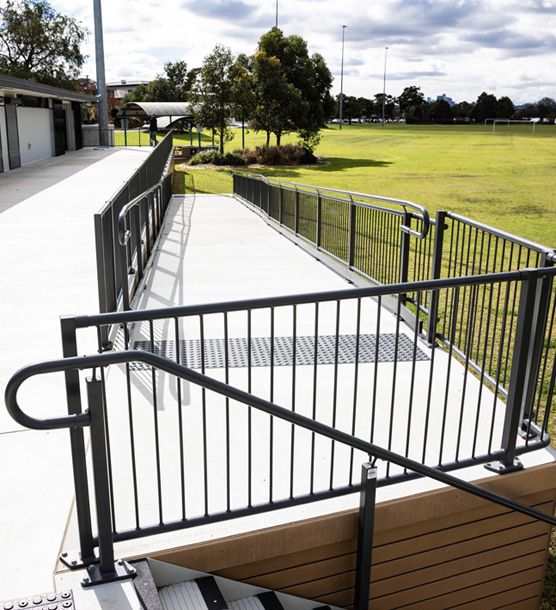
Handrails are minor building features but critical for safety, accessibility, and compliance. With building codes evolving and property owners seeking efficient, long‑term solutions, modular handrail systems are preferred across residential, commercial, and industrial applications. But what makes them stand out?
To provide more insight, we’ve listed the advantages of modular handrail systems. Before this, learn what a modular handrail system is.
What Are Modular Handrail Systems?
Modular handrail systems are railings made from pre-engineered components like posts, rails, brackets, connectors, and infill panels. They can be assembled on-site without welding or custom fabrication. Manufacturers offer standardised profiles and finishes that make installation faster, more consistent, and scalable.
Benefits of Modular Handrail Systems
Modular systems offer flexibility, speed, and ongoing adaptability. Here are some more benefits.
1. Faster Installation
Modular components arrive ready to assemble, reducing installation time by up to 50% compared to fabricated rails.
2. Scalability
Modular railings extend and adapt if the building layout changes.
3. High-Quality Finishes
Modular railings are factory-coated with powder‑coat, galvanised, or stainless steel for uniform aesthetics and durability.
4. Global Compliance
Designed to meet key standards like AS 1657, NCC/ADA requirements, and region-specific safety codes.
5. Cost
Modular rails include fixed-cost components to minimise variations caused by site-made fabrication.
6. Speed and Efficiency
Modular rails are produced more efficiently, allowing for rapid deployment in live environments and minimising site disruptions.
7. Flexibility and Future-Proofing
A modular strategy supports future changes:
- Repositioning: Move handrails easily without fabrication waste
- Expansion: Add sections incrementally as spaces grow
- Upgrades: Switch material styles (aluminium to stainless steel) with minimal effort.
8. Durability and Maintenance
Traditional timber handrails need repeated refinishing due to weathering or UV exposure, and site-welded steel rails might rust or weaken over time. By contrast, modular systems use durable materials, require minimal care, and preserve both appearance and integrity for years.
9. Safety
The NCC (National Construction Code) and various state safety standards in Australia require precise height, grip size, load-bearing performance, and structural durability. Modular systems from ARA Solutions are pre-engineered to meet or exceed these requirements.
- 900 -1,100 mm minimum height above stairs
- Guardrail height must be at least 1,000 mm where falls are common
- Load capacity of 0.6kN for handrails
- Rail gaps must not exceed 125mm
- Options for tactile finishing and colour contrast are suitable for an accessible design.
10. Aesthetic Versatility
Contrary to stereotypes, modular doesn’t mean industrial or generic. Today’s modular rails offer refined aesthetics:
- Sleek aluminium profiles in varied shapes
- Square or round timber-look options with concealed fixings
- Satin, brushed, or mirror finishes in stainless steel
- Optional glass infill, perforated panels, or balusters for design flair.
11. Sustainability
With waste reduction a growing concern, modular handrails are sustainable. They can be disassembled and reused, offering a more eco-friendly long-term solution. Sustainable modular systems align with LEED, Green Star, and NABERS priorities.
Best Practices for Installing Modular Handrails
Here are some tips for installing modular handrails.
- Work with reputable companies like ARA during design to plan rail runs, corners, and material specifics
- Confirm tolerance levels and concrete conditions for anchor points
- Modular systems use bolt-fixed base plates, eliminating welding and ensuring repositioning
- In marine or exposed environments, use sealant and stainless bolts to avoid corrosion
- Test handrails for grip strength and load capacity
- Include LED strips, tactile elements, or anti-counterbalance finishes.
Designing With Modular Systems
Modular rails are not one-size-fits-all. Designers can specify:
- Mid-rail or full-height variants
- Smooth transitions at landings and stairs
- Integrated lighting, branding, or tactile indicators
- Hidden connectors for seamless finishes.
FAQs About Modular Handrail Systems
Here are answers to frequently asked questions about modular handrail systems.
- Are modular handrails as durable as site-welded rails? Manufacturing tolerances ensure performance under load testing, and galvanised or stainless components resist the weather better than site-welded iron.
- Can these be modified on-site? Minor adjustments (such as trimming tubes ≤50 mm) can be done on-site. Larger changes are best handled at the factory for quality assurance.
- How do they handle uneven surfaces? Flexible base plates allow shims to accommodate variations. Adjustable corner posts are also available for tricky layouts.
- What are typical lead times? Standard modular kits are ready 4–6 weeks after design sign-off; Australian fabrication typically takes 2–3 weeks.
- Are they energy-efficient or green? While not active energy-saving devices, modular rails reduce embedded energy through reusability, reduced on-site waste, and low-VOC finishes.
Work With ARA Solutions
Modular handrail systems are flexible, high-performance infrastructure assets. They promote visitor and user safety and adapt to aesthetic and functional design needs. To ensure effective modular rail design and installation, you must work with reputable and experienced organisations.
ARA Solutions is a leader in practical ramp and access solutions, specialising in modular handrail systems. We offer consultation, design, and installation services to ensure your handrails are compliant and safe. Our experienced and dedicated teams work to understand your needs and provide high-quality, professional services.
Contact us online today to speak to one of our professionals.
This article is intended for general information and educational purposes only. It is based on information available at the time of publication and may not reflect subsequent changes to the Disability Discrimination Act, Australian Standards, building codes, or related legislation. Nothing contained in this article should be taken as professional, legal, engineering, or technical advice, and it should not be relied upon as the basis for any decision or action. ARAS makes no representations or warranties as to the completeness, accuracy, or suitability of the information for any particular purpose. To the extent permitted by law, ARAS excludes all liability for any loss or damage arising directly or indirectly from the use of, or reliance on, the content of this article.